
The work downstream of Workday doesn't need an API.
Workday holds the record, but provisioning and re-keying still stall the moment a workflow touches a system with no usable API. StitchOps logs in and finishes it using browser automation and computer vision so the manual steps after Workday finally run on their own.
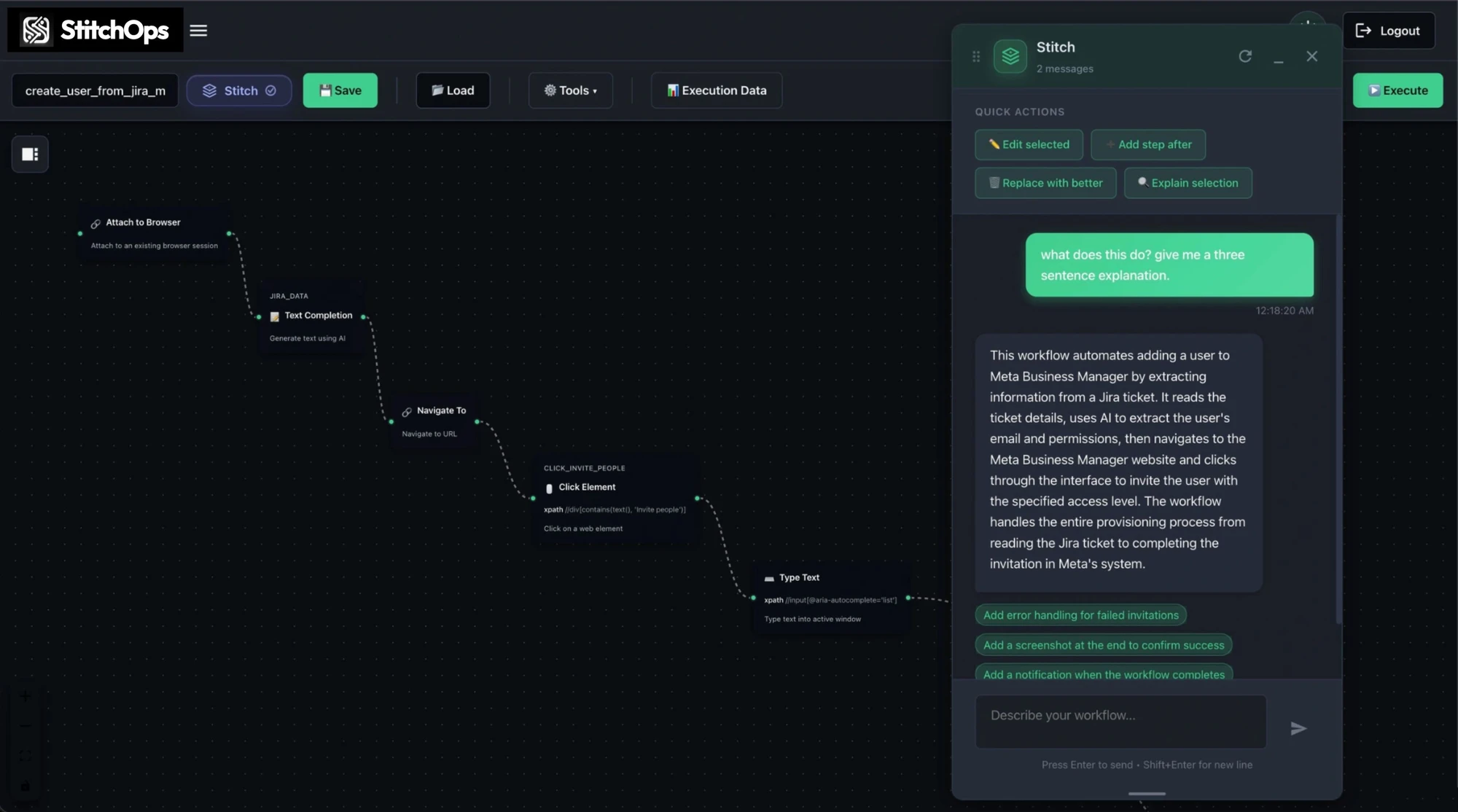
What StitchOps actually is
It does the downstream clicking so your HR team stops.
Point it at the step after Workday, describe the job in plain language, and it logs in, navigates, reads the screen, and finishes it. It runs the same whether the target is a modern portal or a legacy HR console with no integration story.

Runs in a real browser
It logs into the portal Workday can't reach and operates it on screen, no API required.

Sees the screen, not selectors
Computer vision finds each field, so workflows survive when a benefits portal changes its layout.

Connects your whole stack
Read a hire from Workday, provision it across AD, ADP, and PeopleSoft, and write back in one run.

Every action is logged
It records the named field it touched, so a reviewer sees exactly what each provisioning step ran.
Built for the systems Workday hands off to


Why HR teams trust it to run unattended
Reliable enough to leave alone.
Provisioning that only works in a demo isn't worth deploying on a new hire. StitchOps is built to run unattended and self-heal when a portal shifts, with credentials that never leave your own infrastructure.
BYOKV credential custody
Workday and downstream credentials stay in your own key vault. StitchOps never holds them.
Runs in your environment
The agent executes inside your network with an outbound-only connection. No inbound ports.
Deterministic and auditable
Every provisioning action is logged by the named field it touched, so any run is reviewable.
Compliance ready
SOC 2 Type 1 complete, Type 2 in progress, with HIPAA deployments supported via BAA.
See it run on your Workday workflow
Scope one joiner or payroll workflow and watch StitchOps run it live into your downstream systems.
Before and after StitchOps
Trade the provisioning queue for a workflow.
The systems downstream of Workday didn't go away. Your team just absorbed them as manual provisioning that never scales. Here's what changes the day StitchOps takes it over.
From stuck workflow to live automation
Start with one Workday workflow prove it, then expand.
You don't buy a platform on faith. You pick the downstream process that hurts most, watch it run inside your own systems, and let the proof of value make the decision for you.
1. Pick the painful one
Name the downstream system everyone calls unautomatable. That's the workflow we scope.
2. Describe it in plain language
Tell the AI assistant the steps. It builds a runnable workflow on a visual canvas.
3. Run it in your environment
The agent executes inside your network, pulling credentials from your own vault.
4. Measure, then expand
See hours and dollars recovered, then add the next system as a sub-workflow.
What's your next move?
The downstream work isn't going to automate itself.
It's been manual this long because everyone assumed it had to be once Workday's API ran out. The only question left is whether you want to see it run, dig into the details first, or leave it manual for another quarter.