
Zapier stops where the API stops. Your hardest work lives past that line.
Zapier is great when both apps have an API. Most enterprise systems don't. StitchOps runs the portals, legacy apps, and government systems by clicking through them like a person would.
What StitchOps actually is
It automates software by operating the screen the way you would.
Zapier passes data between apps through APIs. StitchOps logs in, reads the screen with computer vision and clicks, types, and extracts. So it reaches the systems that never had an API in the first place.
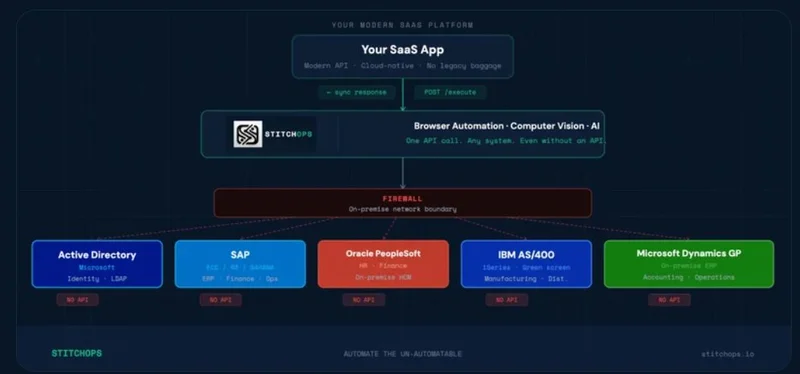
Reaches no-API systems
Web portals, SAP GUI, QuickBooks Desktop, state and payer portals. The 91% Zapier can't connect.

Self-heals when UIs change
Computer vision adapts when a portal moves a button. No brittle recorded selectors to maintain.
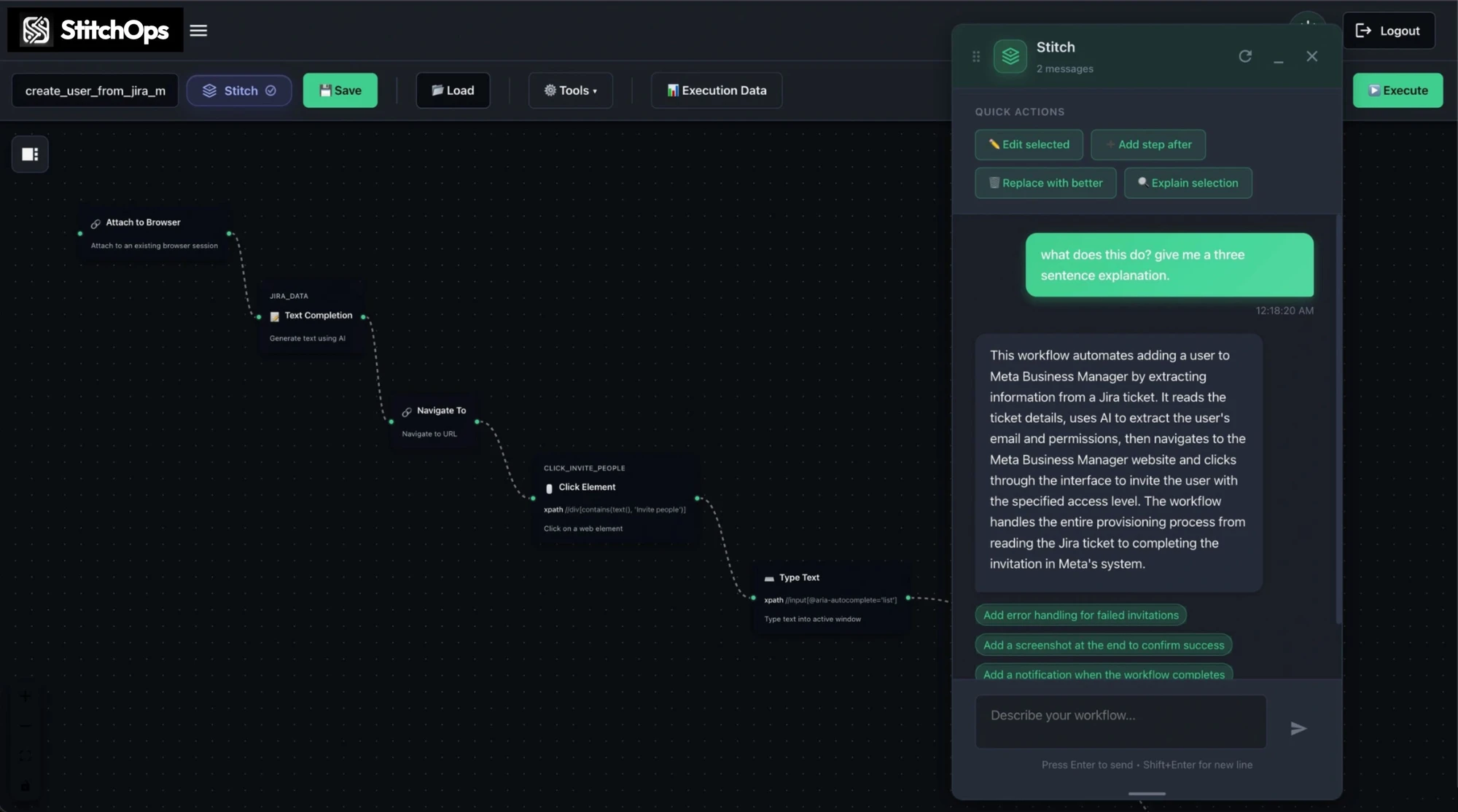
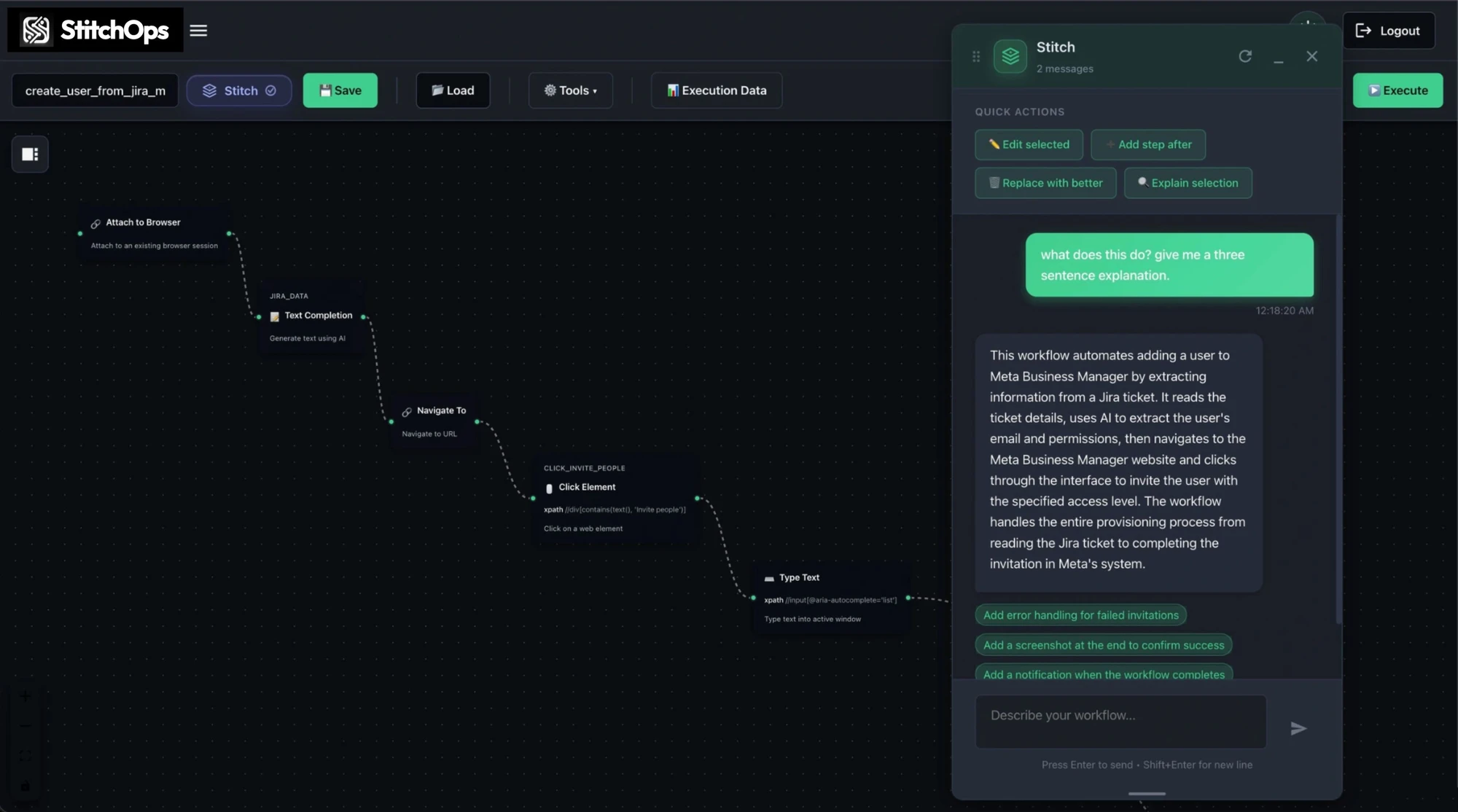
Build it in plain language
Describe the workflow. The AI assistant builds a runnable visual flow. No code, no specialist.

Deterministic and auditable
Same inputs, same outputs. Every action logged by the named element it touched.
Where Zapier ends and StitchOps begins
They solve different halves of the same problem.
Keep Zapier for the API-reachable apps it does well. Add StitchOps for the execution layer that operates everything else, so your automation stops dying at the systems with no integration.
Your week before and after
The work that Zapier left on your plate.
You automated what you could and the rest stayed manual. Here's what changes once the no-API work runs on its own.
Today: manual logins
Someone logs into each portal, checks status, and copies data into a spreadsheet by hand.
Today: brittle scripts
A Selenium script or RPA bot breaks every time a portal changes its layout.
After: runs unattended
StitchOps logs in, pulls and structures the data, and syncs it back automatically.
After: it adapts
When a portal moves a button, computer vision re-perceives the screen and keeps going.
Why teams trust it in production
Proof it holds up where it matters.
Execution happens inside your environment. Credentials stay in your own vault with BYOKV. Every run is deterministic and logged, so it passes the security review that blocks other tools.
Runs in your environment
The agent executes where your systems live. On-prem option means no data egress at all.
Auditable by design
Every action logged by the named element it touched. Defensible in front of an auditor.
Enterprise security posture
SOC 2 Type 1 complete; Type 2 in progress. HIPAA deployments via BAA where PHI is involved.

See it run your workflow
Bring one Zapier-blocked workflow. We'll run it inside the exact system you could never connect.
Switching from Zapier
Migration is additive, not a rip-out.
Start with a single high-impact workflow that Zapier can't reach. We deploy the agent in your environment, prove it with a proof of value, then expand system by system.