
No. It completes it. Workato and other iPaaS tools require an API at both ends, so they cover the API-reachable systems and stop there. StitchOps handles the systems with no API while Workato keeps owning orchestration. Enterprises that already deployed iPaaS are exactly the teams that hit the non-API ceiling — StitchOps removes it.
Workato stops at the API. Your roadmap doesn't.
Workato connects the systems that ship an API. The other 91% of your stack has none. StitchOps runs inside web portals, legacy desktop apps, and terminals using browser automation and computer vision.
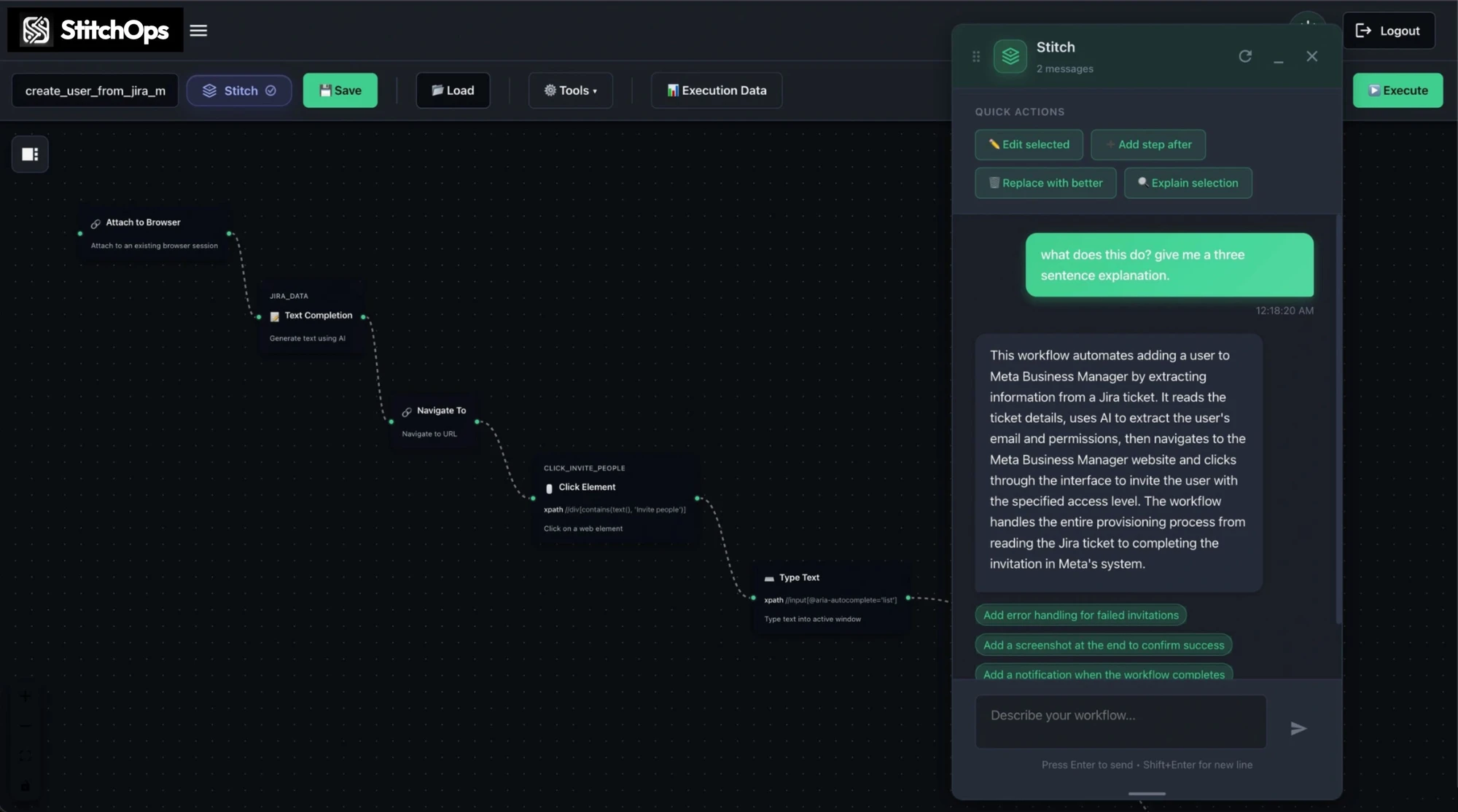
What StitchOps actually is
If a human can log in and click through it, StitchOps can run it.
Workato is an integration engine: it needs an API at both ends. StitchOps is an execution runtime. It logs into the portal, clicks the buttons, reads the screen, and finishes the work — no API required. The two are complementary, not rip-and-replace.
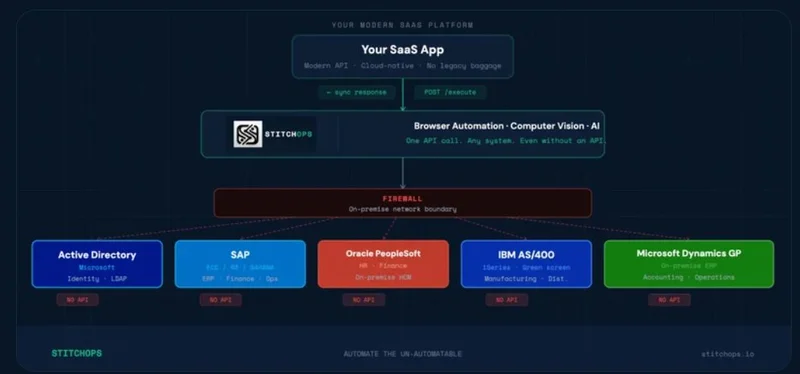
Runs the 91% with no API
Web portals, legacy ERP, terminals, and government systems Workato cannot connect to.
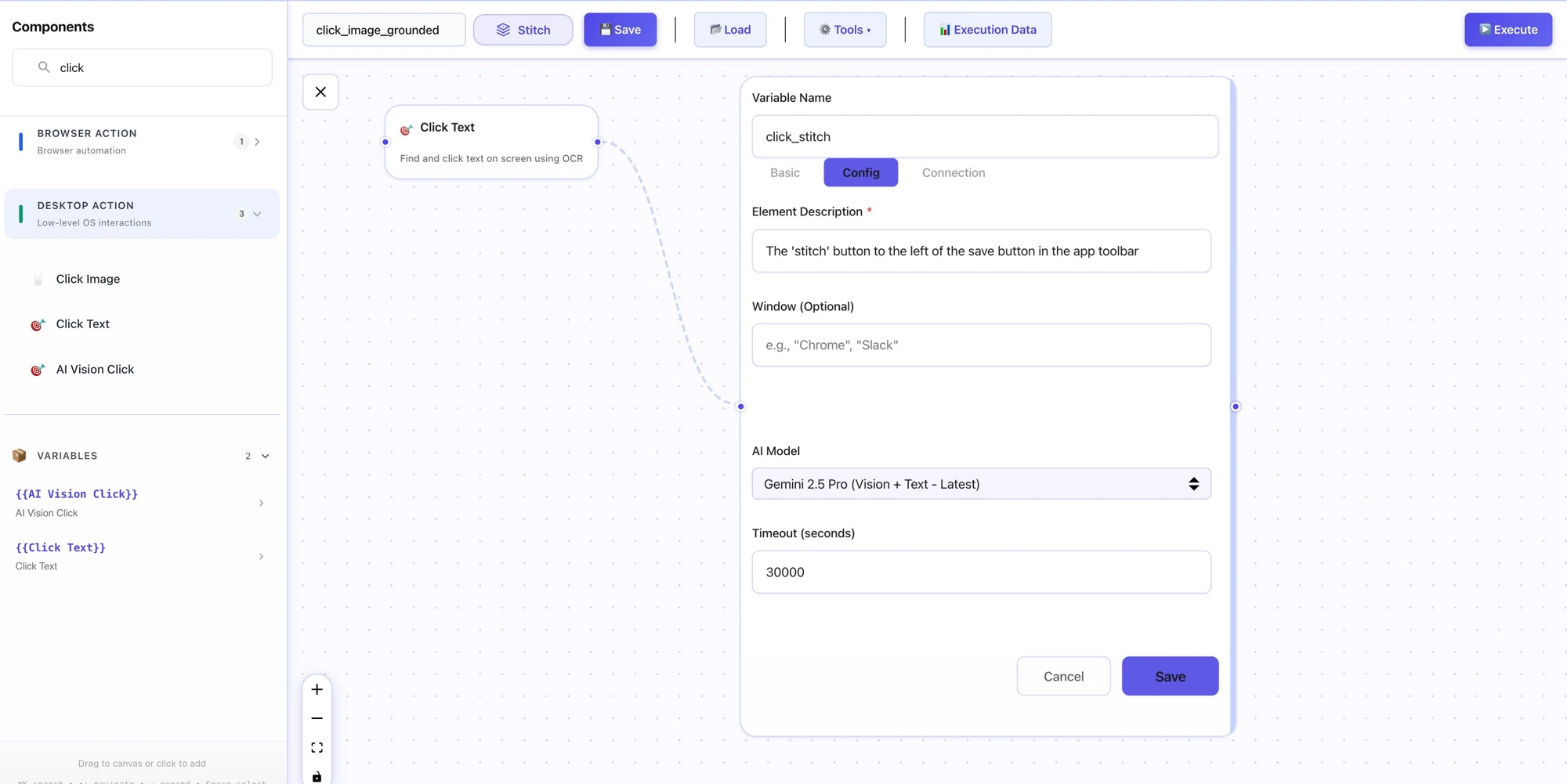
Computer vision, not click recorders
It reads the live screen, so automations adapt when a portal changes instead of breaking.
Deterministic and auditable
Same inputs, same outputs. Every action is logged by the named element it touched.
BYOKV credential custody
Credentials stay in your own vault. StitchOps retrieves a secret at run time and never stores it.
91%
of enterprise systems have no usable API
100%
surface coverage: the 9% with APIs plus the 91% without
3
execution models unified: APIs, browsers, and legacy systems
Why teams trust it on real systems
Built to hold up in production, not just in a demo.
The failure mode that kills traditional automation is a UI change. StitchOps re-perceives the screen and recovers, then logs every step so a reviewer can see exactly what ran. That is why it gets approved in healthcare, financial services, and other regulated environments.

40+
hours saved per week (average for mid-size teams)
$150K+
annual labor-cost savings per team
0
separate tools to stitch together
SOC 2 in progress
Type 1 report complete (April 2026, Sensiba LLP); Type 2 observation window running May through July 2026.
HIPAA via BAA
HIPAA-compliant deployments supported through a Business Associate Agreement where workflows touch PHI.
Watch it run inside your system
Scope one high-impact workflow and see measurable results before any larger commitment.
Your stack today vs. with StitchOps
The non-API work doesn't disappear. It just finds your team.
Everything Workato can reach stays exactly where it is. StitchOps picks up the work that currently falls to manual queues, offshore teams, and brittle scripts.
The work
Today
With StitchOps
Legacy portals and desktop apps
Manual, by hand
Run unattended
Portal changes its layout
Automation breaks
Re-perceives and recovers
Credential handling
Stored in scripts
Stays in your vault (BYOKV)
Audit evidence
Reconstructed later
Logged by named element
Adding a new portal
Weeks of work
Hours, as a sub-workflow
From stalled roadmap to running workflow
Land one workflow, prove it, then expand.
No rip-and-replace. Keep Workato owning orchestration for everything with an API. StitchOps slots in as the execution layer for the systems it can't reach.
1. Pick the blocked workflow
Scope the one non-API system stalling your automation roadmap today.

2. Describe it in plain language
The AI assistant builds a runnable multi-step workflow on a visual canvas — no code.
3. Run it in your environment
The agent runs where your systems live. Credentials stay in your vault.
4. Expand portal by portal
Add each new system as a sub-workflow in hours, not weeks.
Questions buyers evaluating Workato ask
Does StitchOps replace Workato?
Isn't this just RPA with a new name?
No. RPA records clicks against fixed selectors. Click-recorder automations break every time the UI moves an element, which is why RPA carries heavy maintenance. StitchOps uses computer vision and AI-driven execution to interpret the screen dynamically, so automations stay durable when interfaces change and self-heal instead of silently failing.
Where does our data and credentials go?
Execution happens inside your environment. Sensitive workflow data does not route through shared infrastructure, and an on-premises option eliminates data egress entirely. Credentials stay with you via BYOKV: StitchOps never holds them, and the agent retrieves a secret at run time without persisting it. Telemetry is content-free.