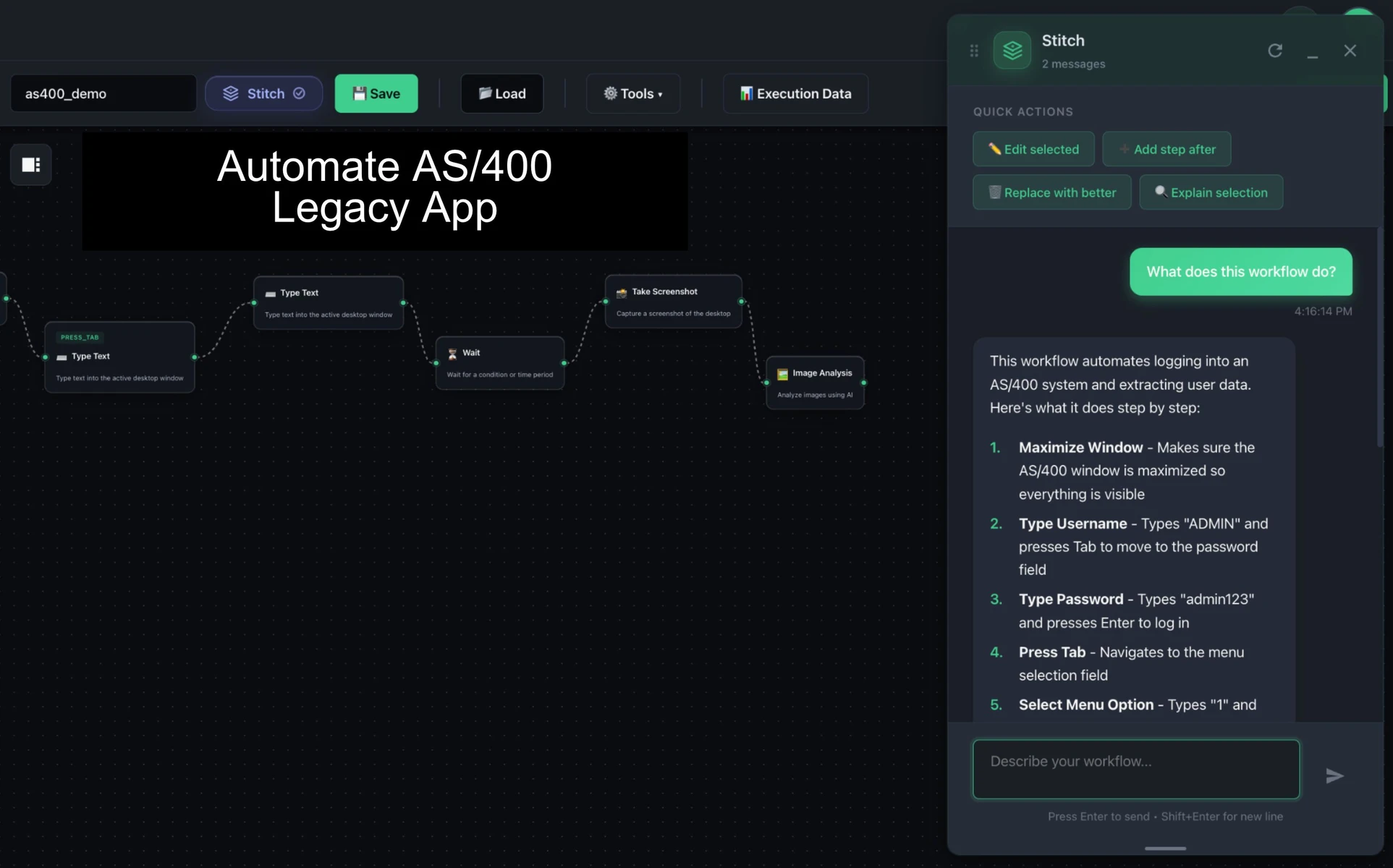
ServiceNow stops where your APIs stop. Your work doesn't.
ServiceNow orchestrates beautifully, then hits a wall: the portals, legacy apps, and terminals with no usable API. StitchOps executes there too, anywhere a human can log in and click.
What StitchOps actually is
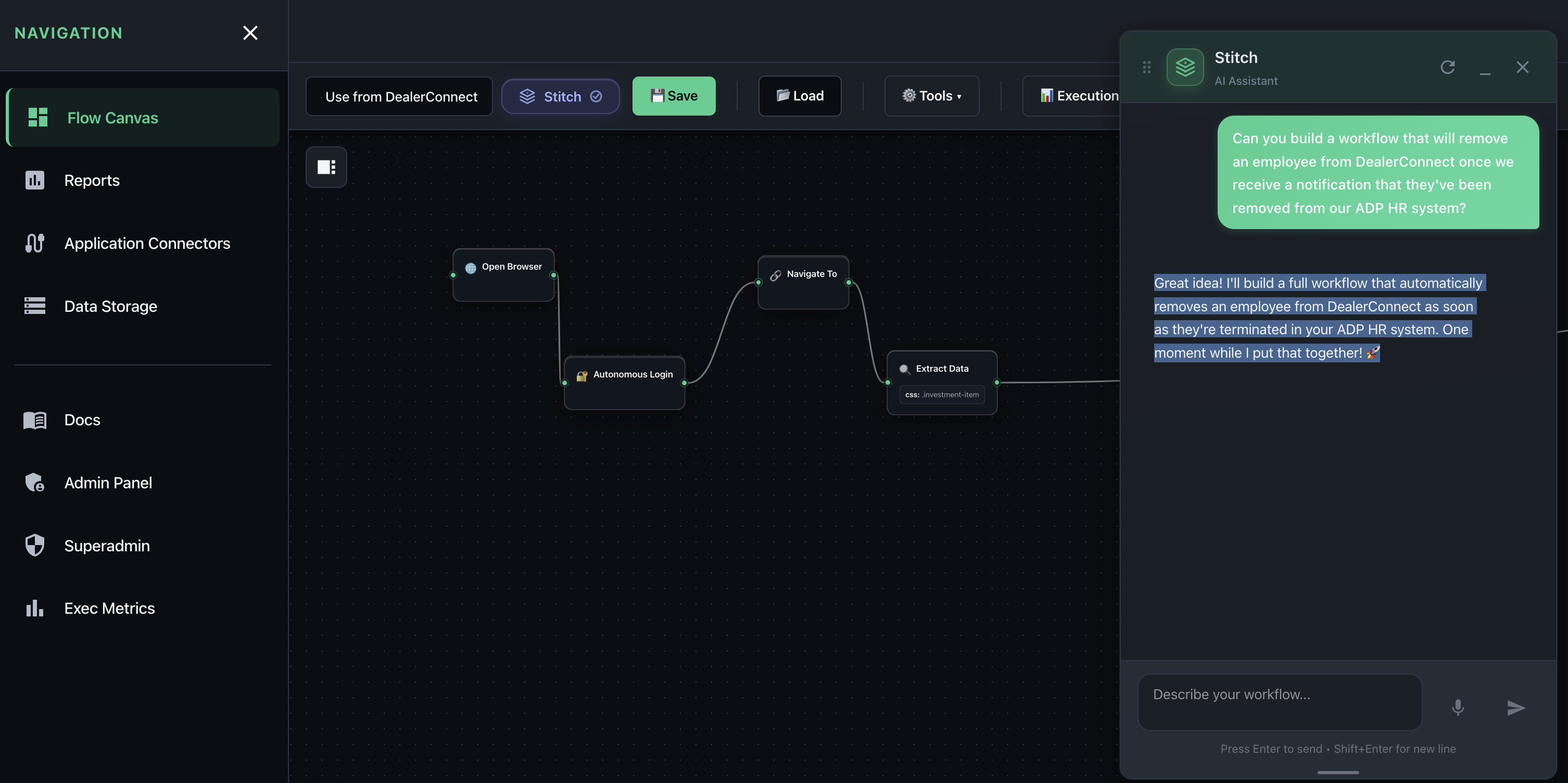
It runs the systems no integration can reach.
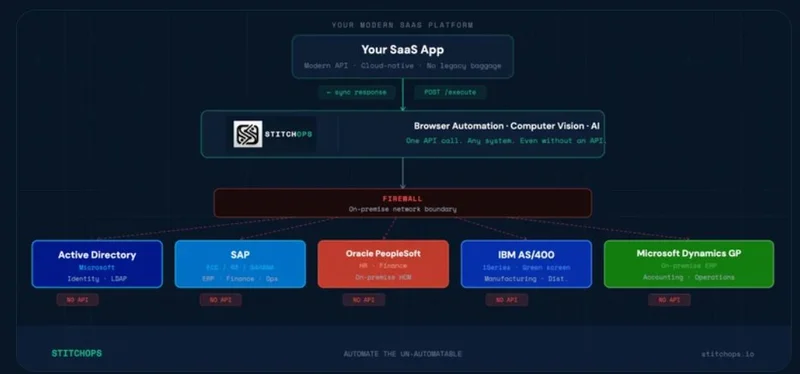
ServiceNow is an orchestration platform: it tells connected systems what to do. StitchOps is an execution runtime. It logs in, reads the screen with computer vision, and clicks through the work itself, even when there is no API to call.
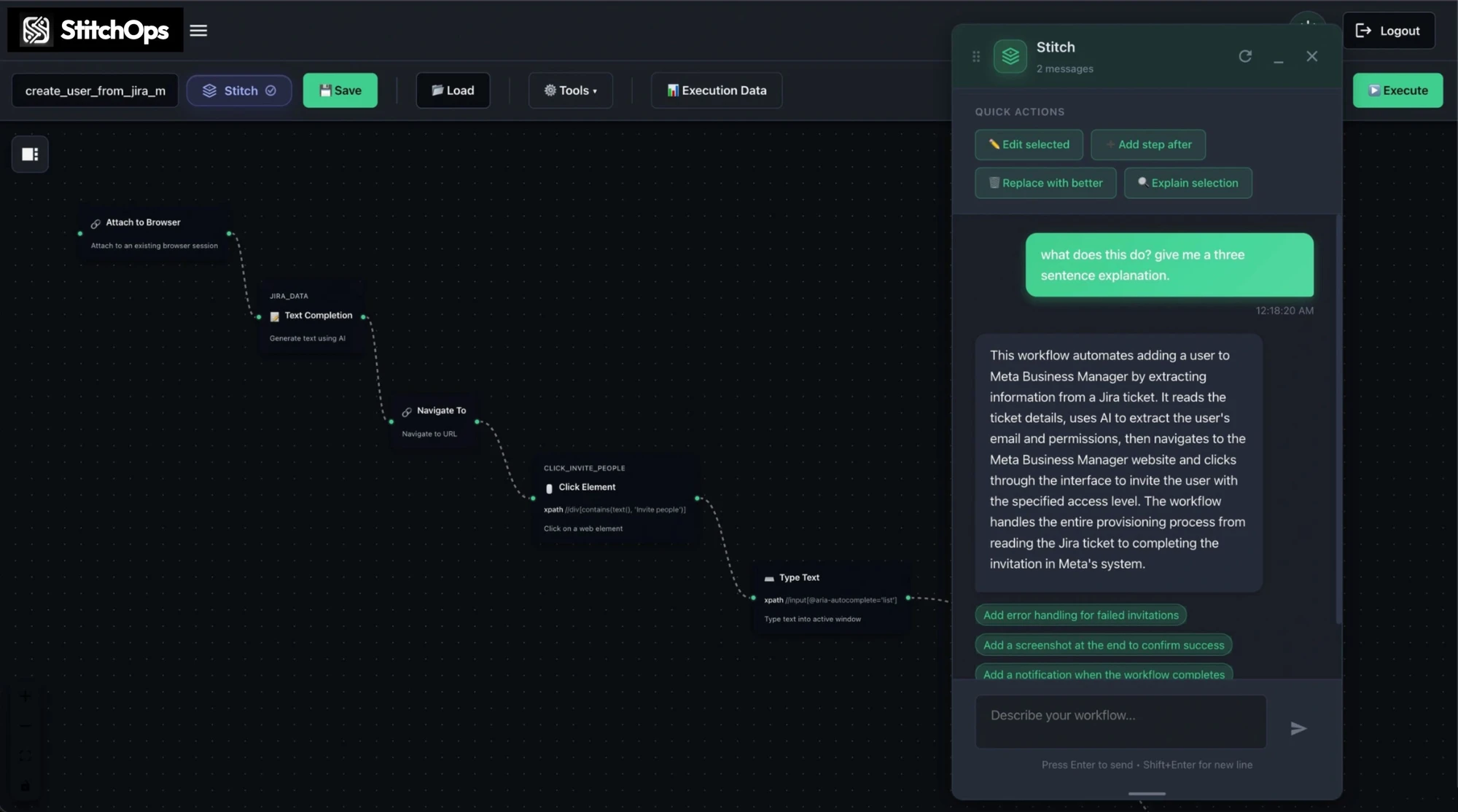
Operates the screen, not the API
Browser automation plus computer vision drive any portal, legacy desktop app, or terminal a person can use.
Self-heals when portals change
It targets elements by what they are, not brittle selectors, so a relayout doesn't silently break the run.
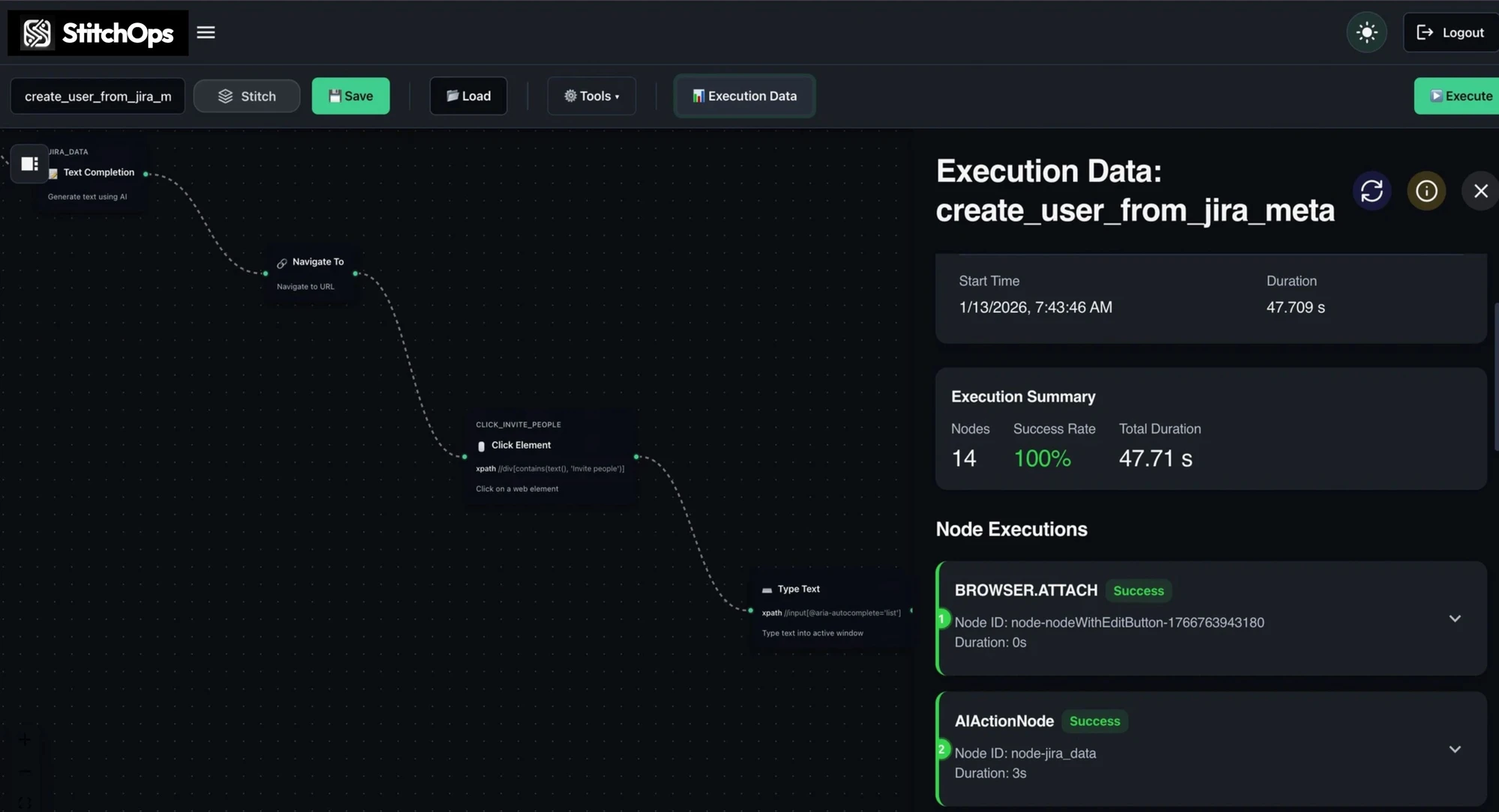
Deterministic and auditable
Same inputs, same outputs. Every action is logged by the named element it touched, not an opaque pixel.
Credentials never leave you
Bring Your Own Key Vault: the agent runs in your environment and never persists your secrets.
Why teams trust it to run unattended
The numbers behind 100% surface coverage.
ServiceNow covers the API-reachable systems well. StitchOps covers those plus the ~91% with no API, so one runtime reaches the entire estate, including the systems IT flagged as unautomatable.
Not RPA with a new coat of paint
Click recorders break on every UI change. Computer vision interprets the screen and adapts.
Composable, not rip-and-replace
It runs alongside your identity layer and API runtime as the execution layer they can't build.

See it run in your hardest system
Scope one high-impact workflow, watch the agent execute it live, and measure the result before any commitment.
Your estate today vs. with StitchOps
What changes once the API ceiling is gone.
The work ServiceNow can't reach doesn't disappear. It lands in manual queues and brittle scripts. Here is the same estate before and after StitchOps removes that ceiling.
Switching from ServiceNow
From stranded backlog to one proven workflow.
Keep ServiceNow for what it does well. Start with the proof of value: scope one workflow it can't reach, deploy the agent in your environment, and prove the result before you expand.
1. Pick the stranded workflow
Choose the no-API system that floods your manual queue: a payer portal, legacy ERP, or filing portal.
2. Deploy in your environment
The agent runs where your systems live. Credentials stay in your vault via BYOKV.
3. Prove the result
Watch it execute live and measure hours recovered and errors removed against today's baseline.
4. Expand alongside ServiceNow
Add systems one at a time. StitchOps completes the stack, it doesn't replace your orchestration.