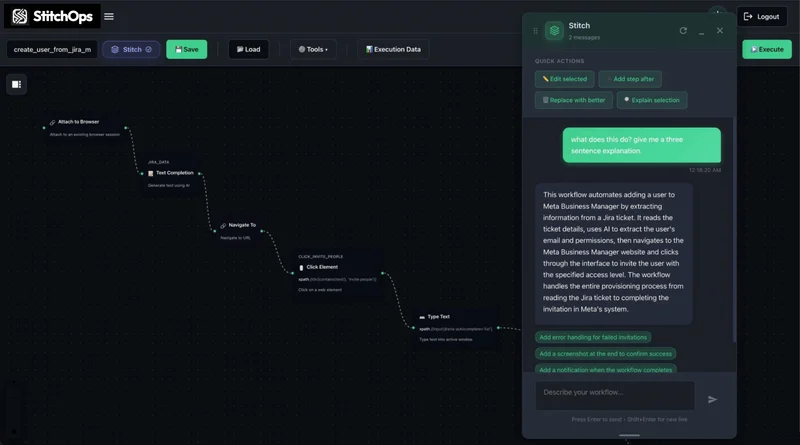
NemoClaw governs your API workflows. StitchOps runs the other 91%.
NemoClaw adds real governance on top of an API-first engine. But it stops the moment a workflow hits a system with no API. StitchOps executes there too, anywhere a human can log in and click.
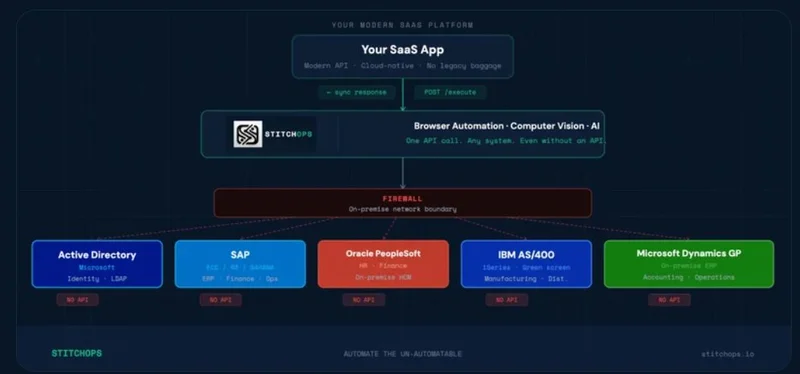
What StitchOps actually is
It runs software like a person does clicking through screens.
NemoClaw orchestrates AI agents over systems that expose an API. StitchOps uses browser automation and computer vision to operate the screens directly. If a human can log in and click through it, StitchOps can run it. No API required.
Reaches the 91% with no API
Web portals, legacy desktop ERP, terminal apps, and government systems NemoClaw can't touch.

Computer vision, not brittle selectors
Finds elements by appearance and context, so workflows self-heal when a UI changes.

Deterministic and auditable
Same inputs, same outputs, every time. Every action logged by the named element it touched.

Credentials never leave you
BYOKV resolves secrets from your own vault at runtime and never persists them.
Where NemoClaw stops
You can govern what NemoClaw does. You can't make it reach what it can't reach.
OpenClaw calls tools. Tools require APIs. NemoClaw adds access controls and guardrails on top, but when a workflow touches a system with no API, the governance layer has nothing to govern. StitchOps is the execution runtime that runs there instead.

API-connected cloud workflows
Where NemoClaw is strong: orchestrating and governing agents over systems with APIs.
The non-API surface
Where it stops: legacy ERP, payer portals, terminal apps, and government systems with no API.
Why teams trust the no-API runtime
Built to survive real systems, not just demos.
The reason automation fails in production is that interfaces change. StitchOps uses vision-driven, self-healing execution, so the workflow adapts instead of breaking. Customers report 20 to 40 fewer maintenance hours per month versus click-recorder tools.
Deterministic by design
Identical inputs always produce identical outputs, a requirement for SOC 2 and HIPAA workflows.
Auditable by default
Every action is logged by the named element it touched, not an opaque pixel.
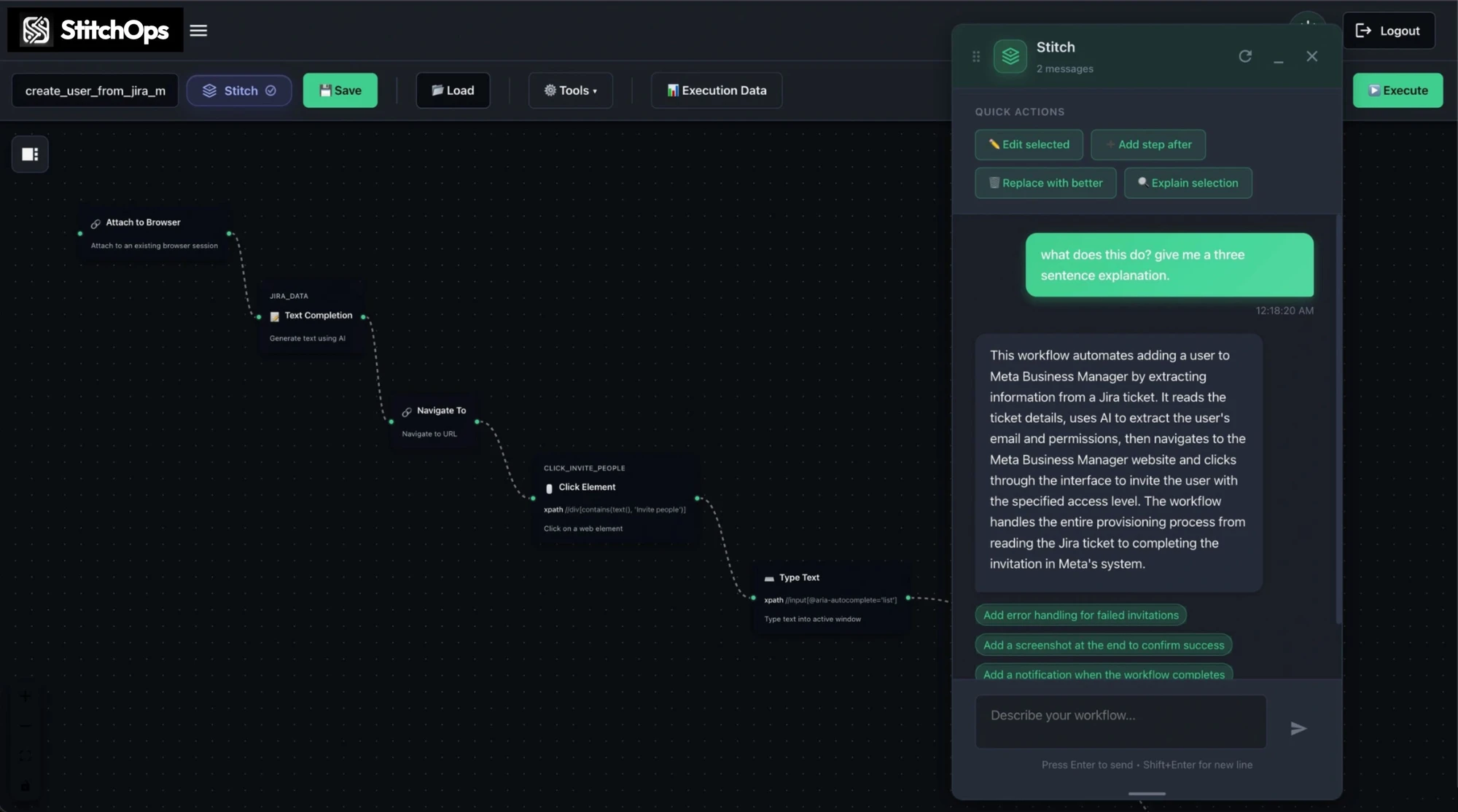
See it run on your hardest system
Pick one workflow NemoClaw can't reach. We deploy in your environment and prove it before any commitment.
Before and after StitchOps
Your automation roadmap, with the non-API ceiling removed.
NemoClaw and your iPaaS stay in place for the API-connected work. StitchOps clears the part of the backlog that has no integration path and never will.
Switching from NemoClaw
From blocked workflow to proven result, without a rip and replace.
StitchOps is complementary infrastructure. Keep NemoClaw for the API-connected, governed work and add StitchOps as the execution runtime for everything it can't reach. Most teams are live in two to four weeks.
1. Pick the blocked workflow
Choose the one your team gave up automating because the system has no API.
2. Deploy in your environment
The agent runs where your systems live. BYOKV keeps credentials in your own vault.
3. Prove it on real runs
Watch it execute inside the exact system NemoClaw couldn't reach, with full logs.
4. Expand portal by portal
Add the next system as a sub-workflow. New portals take hours, not weeks.