
No. It completes the stack. n8n keeps owning the orchestration and the API-reachable systems. StitchOps is the execution runtime that handles the 91% with no API. They run side by side, and a single workflow can mix API steps and screen-driven steps.
n8n stops at the API. Your hardest workflows live past it.
n8n is great at wiring together systems that expose an API. But most enterprise work hides in portals, legacy desktop apps, and terminals with no API at all. StitchOps runs there too, anywhere a human can log in and click.
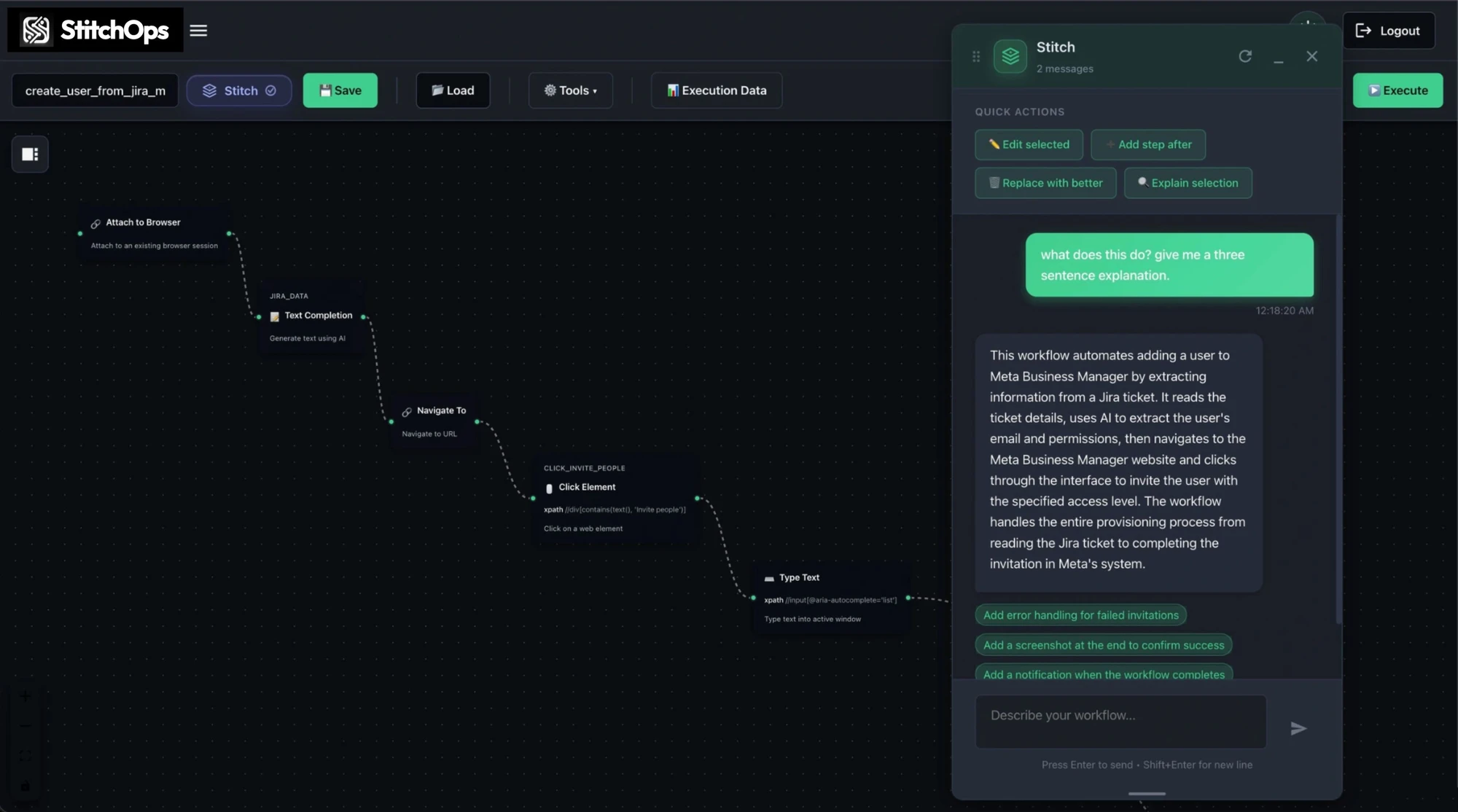
What StitchOps actually is
It runs the systems that don't have a connect button.
n8n needs an API or a node on both ends. StitchOps watches the screen, reads it like a person, and clicks, types, and reads to get the job done. Same workflow canvas you already like, just no API requirement.
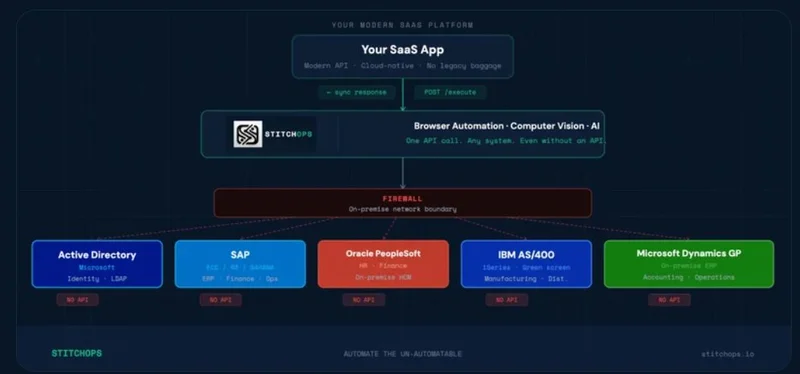
Reaches the 91% with no API
Portals, SAP GUI, AS/400, government sites. If a person can log in, it runs.

Computer vision, not brittle selectors
It reads the screen like a person, so a layout change doesn't break the run.
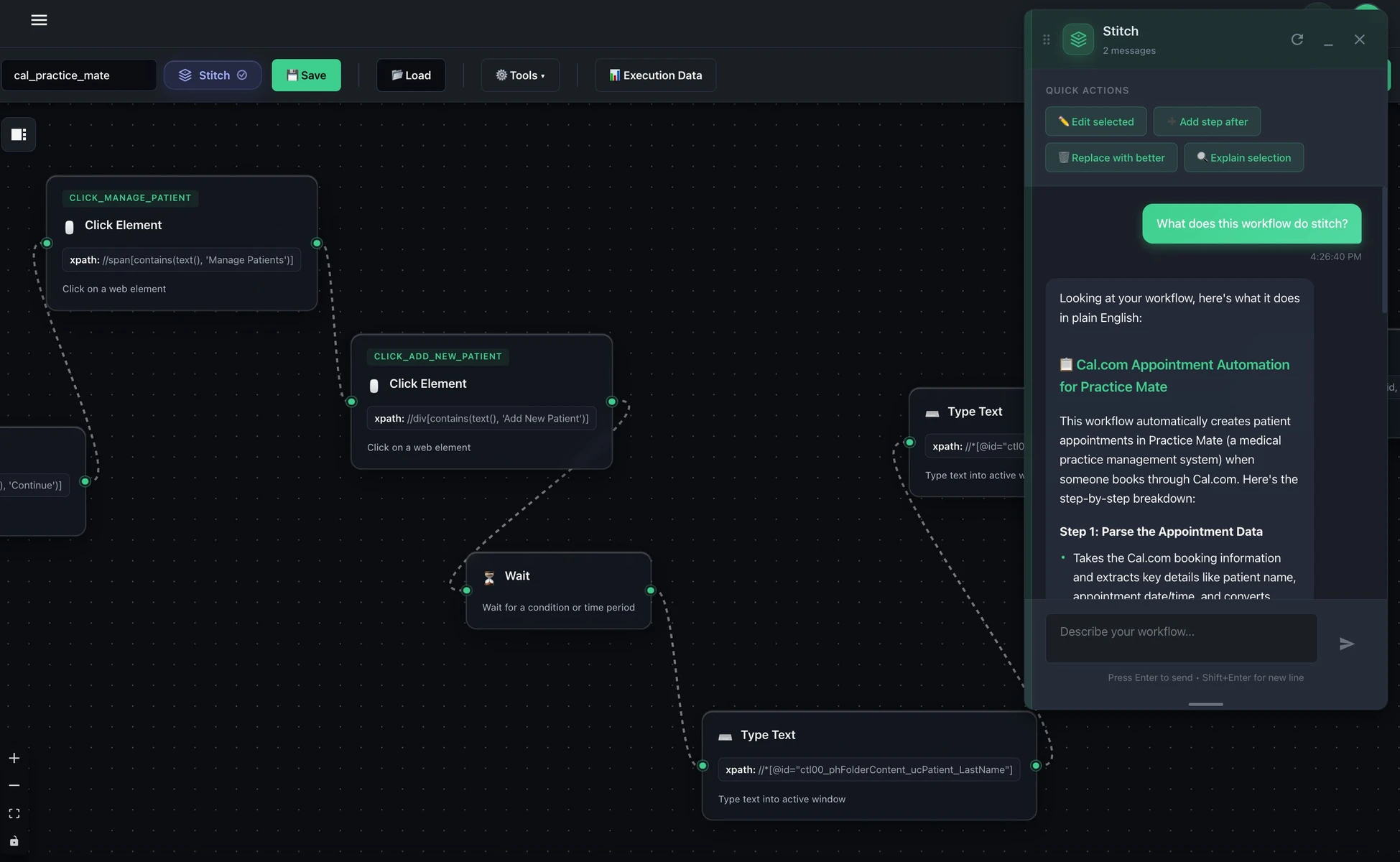
Built like the canvas you know
A visual node graph plus an AI assistant that writes the workflow from plain English.
Credentials never leave you
BYOKV keeps secrets in your own vault. The agent runs inside your environment.
91%
of enterprise systems have no usable API. StitchOps covers them.
100%
surface coverage: the API-reachable 9% plus the no-API 91%.
3
execution models unified: APIs, browsers, and legacy systems.
Why teams trust it in production
Demo-proof is easy. This is production-proof.
The hard part of no-API automation is staying up when a portal changes. StitchOps re-perceives the screen and recovers instead of silently failing, and every action is logged by the named element it touched, so a run is auditable.
40+
hours saved per week, average for mid-size teams.
$150K
annual labor-cost savings per team, on average.
0
separate tools to stitch together. One runtime.

Self-healing when portals change
A tiered fallback chain finds the element instead of breaking on a moved button.
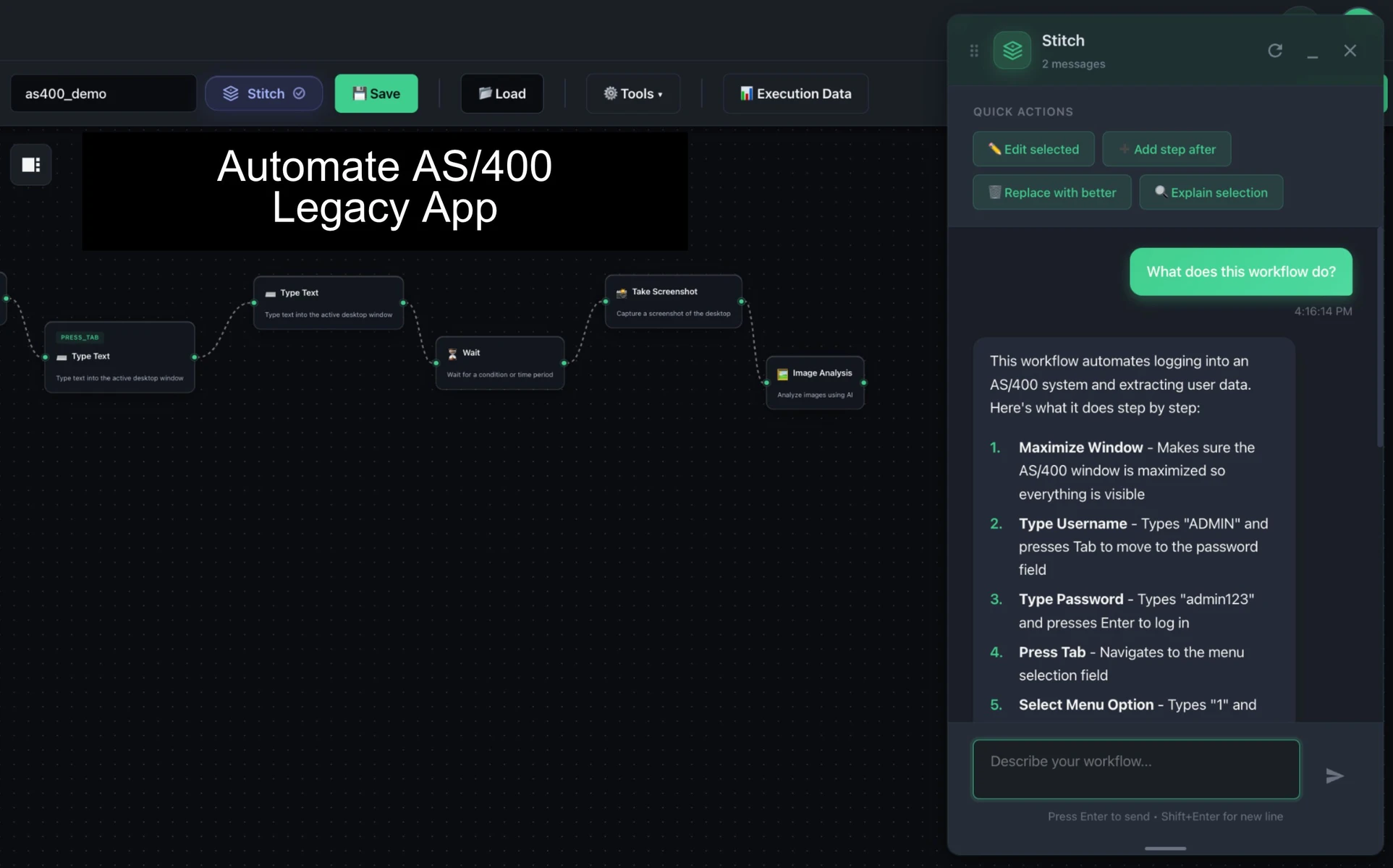
Runs on systems with no API
Here it's driving a legacy AS/400 application end to end, no integration required.
Pick the workflow n8n couldn't finish
We deploy the agent in your environment and prove one high-impact workflow before any larger commitment.
Before and after
Same goals. The no-API wall just disappears.
You keep n8n for everything it already does well. StitchOps picks up the part of the roadmap that stalled the moment it hit a system without an API.
Your workflow today
With n8n alone
With StitchOps added
System has no API or node
Dead end
Runs anyway
Portal changes its layout
Automation breaks
Self-heals and recovers
Legacy desktop / terminal app
Manual or custom script
Driven by the agent
Credentials and sensitive data
Leaves your network
Stays in your vault (BYOKV)
Audit asks what the bot did
Hard to evidence
Every action logged by name
From stuck to running
Four steps from a blocked workflow to live.
No rip and replace. You scope the one workflow that stalled, and StitchOps runs it inside your environment before you commit to anything bigger.
1. Scope the blocked workflow
Pick the highest-impact job that stalled at a no-API system.
2. Describe it in plain English
The AI assistant builds the visual workflow. No coding required.
3. Run it in your environment
The agent executes inside your network. Credentials stay in your vault.
4. Prove it, then expand
See measurable results, then add the next portal or system.
The questions n8n evaluators ask
Does StitchOps replace n8n?
Isn't this just RPA with a new name?
No. Old RPA records fixed selectors. Click-recorders break every time the UI moves, which is why RPA carries heavy maintenance. StitchOps uses computer vision and AI-driven execution to interpret the screen, so automations stay durable when interfaces change.
Where does our data and credentials go?
They stay with you, via BYOKV. The agent runs inside your environment and retrieves each secret from your own key vault at execution time, then never persists it. Telemetry is content-free. SOC 2 Type 1 is complete and Type 2 is in progress, with HIPAA-compliant deployments supported via a BAA structure.