
Make automates the apps with a connector. StitchOps automates the rest.
Make is great when every app in the scenario has an API. But roughly 91% of enterprise systems have none— the vendor portals, desktop tools, and internal apps where your scenarios dead-end. StitchOps runs anywhere a human can log in and click.

What StitchOps actually is
It runs the busywork inside apps that have no connector.
Think of the vendor portals and desktop tools your team keys into by hand every day. StitchOps logs in, clicks, reads, and types just like a person — then self-heals when the screen changes. Make can't reach those apps at all.
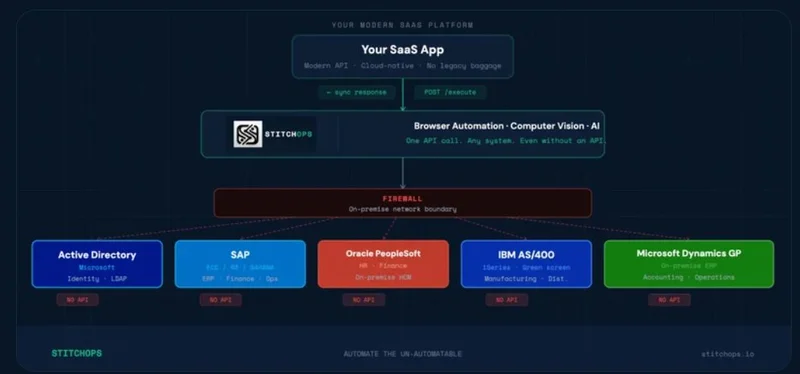
Reach the apps Make skips
Vendor portals, desktop tools, internal apps, legacy ERP — no connector required.
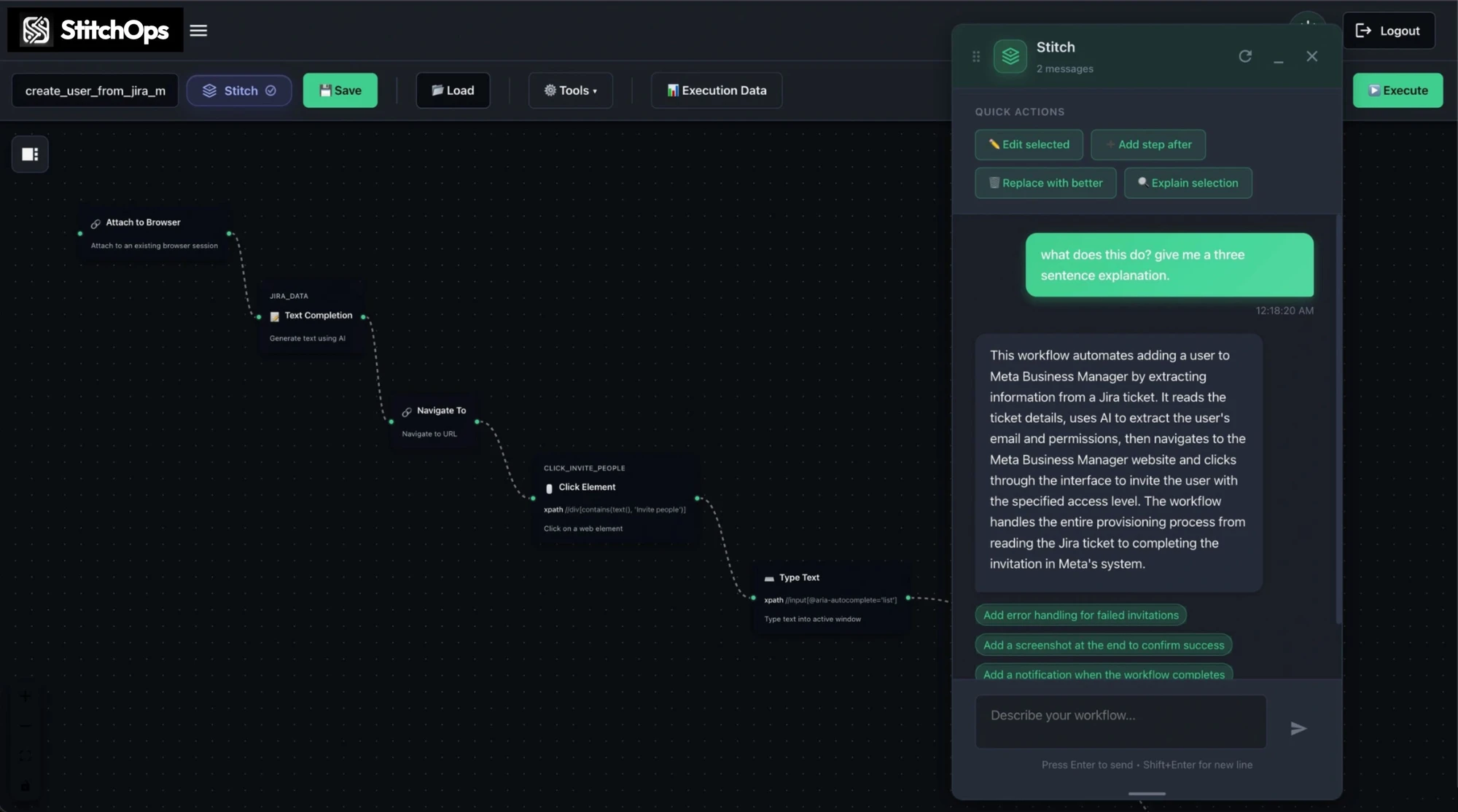
Build in plain language
Describe the workflow. The AI assistant builds a runnable visual graph — no module wiring.

Watch every run, line by line
Per-node execution logs and success rates. Every action logged by the element it touched.
Credentials never leave you
BYOKV keeps secrets in your own vault. The agent runs in your environment, not ours.
Why teams trust it on real systems
Built by people who saw automation break in production.
StitchOps was founded by automation veterans from Opsware, Okta, HP, and Workday after watching demo-ware fall apart against real systems. It's deterministic and auditable— same inputs, same outputs, every action logged — so it holds up where a brittle scraper would silently break.
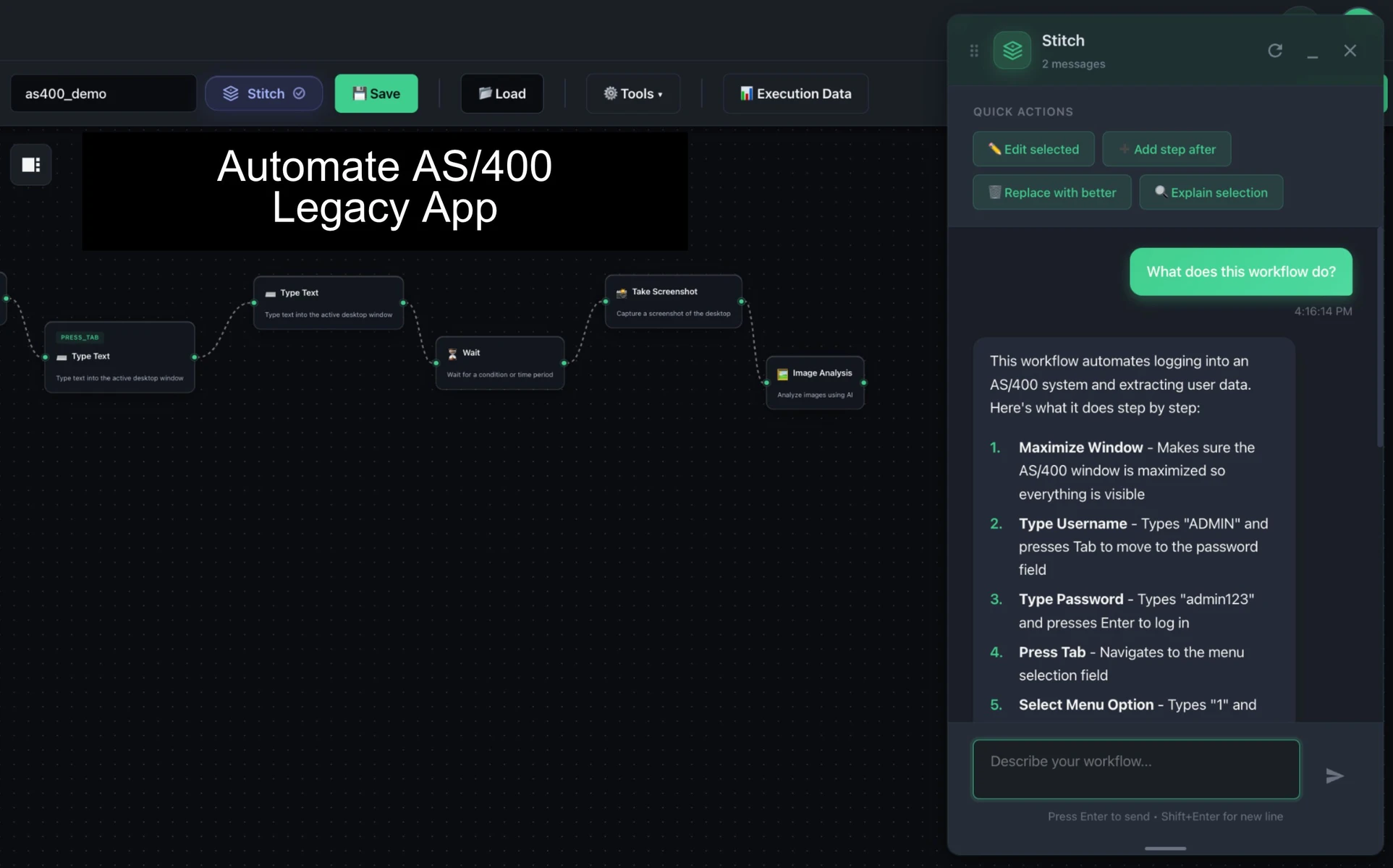
Durable on legacy systems
Automates green-screen terminals and desktop ERP in the same runtime as browser work.
Secure by architecture
In-environment execution, BYOKV credential custody, content-free telemetry. SOC 2 Type 1 complete.
See your blocked scenario run
Pick the one system your Make scenario couldn't reach. We'll show it running in StitchOps.
Your automation, before and after
The work Make leaves on your team's plate.
Make handles the connected stack beautifully. The problem is everything past the connector list — still manual, still brittle, still a queue that never shrinks.
Adding StitchOps to Make
From blocked scenario to live in four steps.
Keep Make for the connected stack. Add StitchOps for the no-connector work through a proof of value— one workflow, deployed in your environment, measurable results before any bigger commitment.
1. Pick the blocked workflow
The one system Make can't reach — the vendor portal, the desktop tool, the internal app.
2. Deploy in your environment
The agent runs where your systems live. Credentials stay in your own vault via BYOKV.
3. Author in plain language
Describe the steps. The AI builds a runnable visual workflow and you watch it run.
4. Prove it, then expand
Measure the result on one workflow. Add the next portal in hours, not weeks.