
No. StitchOps is complementary, not a rip-and-replace. Keep your existing tools owning orchestration and the API-reachable work. StitchOps slots in as the execution runtime for the systems with no API, removing the ceiling your current stack hits.
ClaudeCowork stops at the API. Your hardest systems start there.
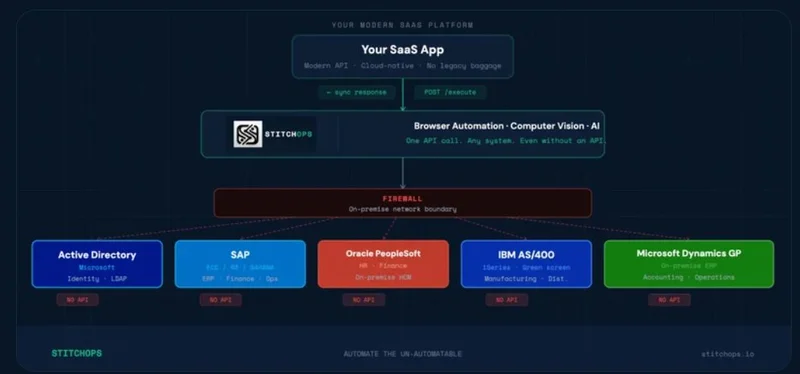
ClaudeCowork is sharp on systems with an API. But roughly 91% of enterprise software has none. StitchOps executes there too, using browser automation and computer vision so a workflow runs anywhere a person can log in and click.
What StitchOps actually does
It logs in and clicks through your systems for you, even the ones with no way to plug in.
ClaudeCowork is strong when a system exposes an API. The moment a workflow hits a portal, legacy desktop app, or terminal with none, that path ends. StitchOps reads the screen and drives the UI directly, so the same workflow keeps going where API-only tools stop.

Runs the screen, not the API
Browser automation drives portals and web apps the way a person does, no integration required.
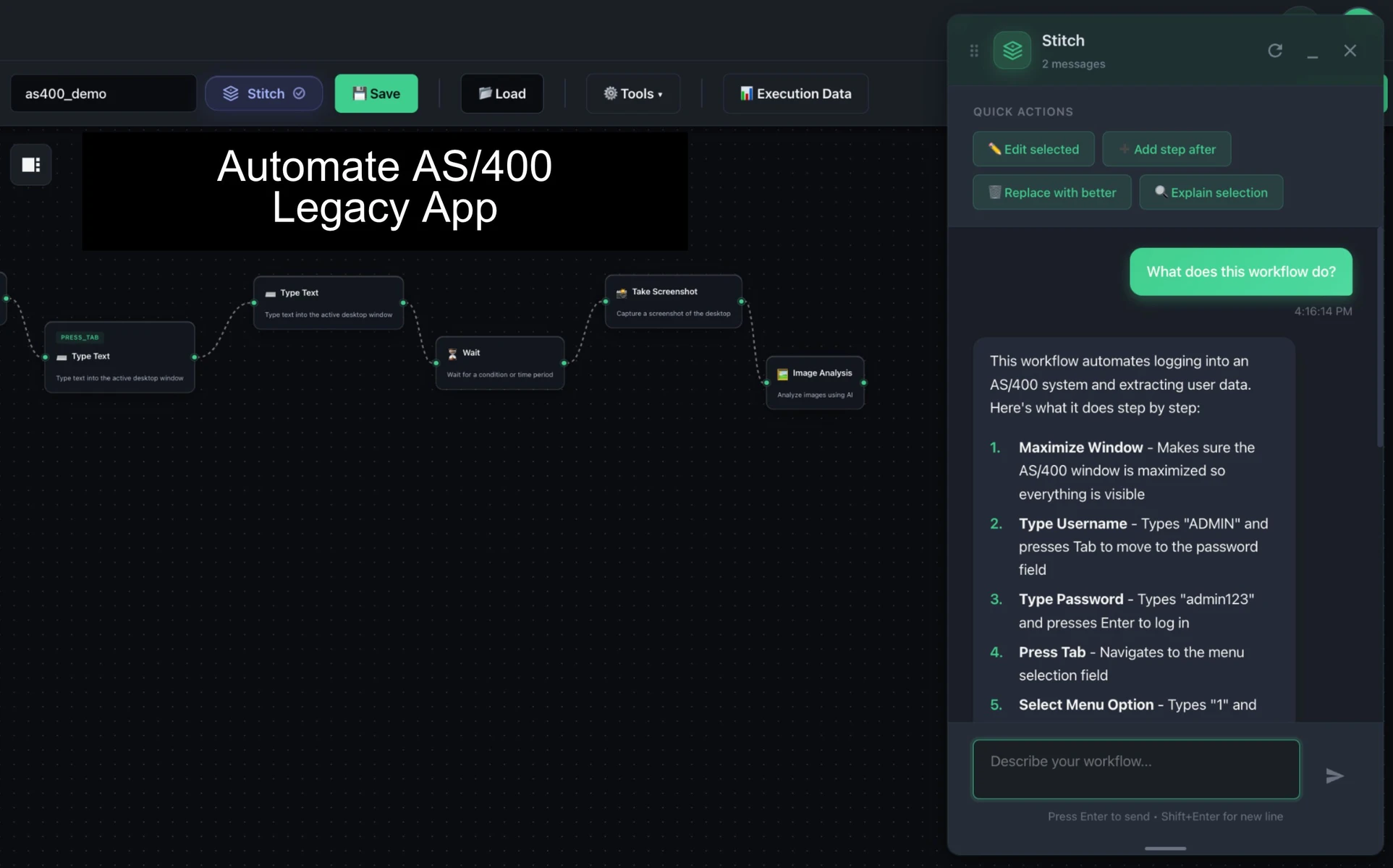
Reads UIs with computer vision
It sees and targets on-screen elements, so automations survive layout changes instead of breaking.

Same inputs, same outputs
AI authors the workflow, then execution replays deterministically with every action logged.
Credentials never leave you
BYOKV keeps keys in your own vault. The agent runs in your environment and holds nothing.
91%
of enterprise systems have no usable API
100%
of the surface covered, API and no-API
0
separate tools to stitch together
Why teams trust it on real systems
Built to hold up in production, not just in a demo.
The hard part of no-API automation is surviving messy, changing systems under audit. StitchOps was built by automation veterans from Opsware, Okta, HP, and Workday for exactly that, with security controls reviewers actually accept.
40+
hours saved per week for mid-size teams
$150K+
annual labor-cost savings per team
3
execution models unified in one platform
Your keys, your vault
BYOKV means StitchOps never holds credentials. The agent retrieves a secret at run time and never persists it.
Runs in your environment
In-environment or on-prem execution with content-free telemetry, so sensitive data never traverses shared infrastructure.
Audit-ready by design
SOC 2 Type 1 complete (Apr 2026, Sensiba); Type 2 observation window May to July 2026. HIPAA via BAA where PHI is touched.
See it run on a system you can't automate today
Scope one high-impact workflow. We deploy the agent in your environment and show measurable results before any larger commitment.
Before and after the switch
The work that stalls on an API-only tool, finished.
ClaudeCowork handles the API-reachable part well. This is what changes for the non-API systems it can't reach, the ones eating your team's day in manual logins and re-keying.
Your no-API work
With an API-only tool
With StitchOps
Systems with no API
Out of scope
Automated
When a portal changes
Breaks silently
Self-heals
Where credentials live
Often handed over
Stay in your vault
Audit trail
Hard to evidence
Every action logged
Time to first result
Long build
Proof-of-value fast
From blocked workflow to running automation
Land on one workflow, prove it, then expand.
No-API automation is show-don't-tell, so the proof of value is the whole motion. Pick the workflow that's blocked today, and watch it run inside the exact system you could never automate before.
1. Scope the blocked workflow
Pick the highest-pain no-API system your current tools can't touch.
2. Describe it in plain language
The AI assistant builds a runnable workflow on a visual canvas, no coding.
3. Deploy in your environment
The agent runs where your systems live, pulling secrets from your own vault.
4. Run it unattended
Deterministic, logged execution that self-heals when the interface changes.
Switching from ClaudeCowork
Do we have to rip out ClaudeCowork?
Isn't this just RPA with a new label?
No. RPA records clicks against fixed selectors and breaks when the UI moves. StitchOps uses computer vision to interpret the screen dynamically, so automations stay durable through interface changes instead of needing constant specialist upkeep.
Where does our data and credentials go?
Execution happens in your environment. Credentials stay in your vault. With BYOKV StitchOps never holds your credentials, telemetry is content-free, and an on-prem option removes data egress entirely. This is often the control that gets approved where other tools get blocked.